By the time Europeans arrived in the 16th and 17th centuries, the Three Sisters system was a dominant agricultural method used by many Indigenous nations across North America, including the Haudenosaunee (Iroquois) and others in the Northeast.
THE LEGEND
Many Indigenous cultures have variations of the Three Sisters legend. One common story tells of three inseparable sisters who grew up together in a field.
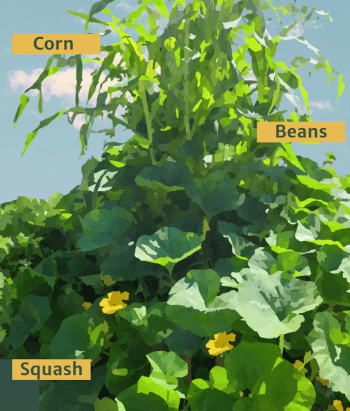
Corn, the eldest, stood tall and strong, offering her stalks as support.
Beans, the middle sister, twined lovingly around Corn, providing nourishment to the soil.
Squash, the youngest, spread her broad leaves across the ground, protecting her sisters’ roots and suppressing weeds.
The sisters thrived together, each contributing to the well-being of the others. Their harmonious relationship became a symbol of cooperation, mutual support, and the bounty of nature. When separated, they would wither and die.
PLANTING
The Three Sisters planting method is a sophisticated form of companion planting, where each plant benefits the others. Today, the Peak House follows this method when planting.
METHOD
CORN (1) Corn provides a natural trellis for the beans to climb. Corn is planted in the center of the mound. Once the corn stalks are a few inches tall the beans are planted.
BEANS (2) Beans are planted around the corn. Beans, as legumes, fix nitrogen in the soil, enriching it for the corn and squash.
SQUASH (3) Finally, squash is planted around the perimeter of the mound. Squash’s large leaves shade the soil, retaining moisture and suppressing weeds
Watch Our Native American Garden Thrive… ALL SUMMER LONG!